
Communicate

Registrations Open


2025-04-09
GHIBLI-STYLE IMAGES: THE AI-POWERED STYLE THAT WENT VIRAL, BUT DO YOU KNOW ITS BACKGROUND?
Author: María Paula Vélez Villegas
Unicab Grade 11
Support teacher: Laura Yeraldin Flórez Díaz
ChatGPT, the AI chatbot developed by...
2024-09-05
WHAT DOES THE GIU DO?
Dear readers, In 2018, a group of professionals of the highest human and pedagogical qualities, led by the Rector´s Office and the Academic Coordination, p...

2024-06-09
DIGITAL COMPETENCIES FROM THE UNICAB VIRTUAL SCHOOL
Major technological advances in various fields have led us to adopt digital skills in our daily lives, facilitating many tasks such as scheduling medical app...

2024-05-21
THE REVOLUTION OF NATURAL INTELLIGENCE
Dear readers:
In the midst of a constantly shifting and evolving technological landscape, 2024 presents itself as a significant year and a milestone in t...
Por: By: Unicab Research Group, GIU
martes, 21 de mayo de 2024



Dear readers:
In the midst of a constantly shifting and evolving technological landscape, 2024 presents itself as a significant year and a milestone in this field. The speed and scope of technological change pose a challenge at every level and in every area of knowledge.
Artificial Intelligence is the hottest topic in various media and settings. The very word "artificial" makes many of us uneasy, even though work on machines that mimic human intelligence has been ongoing for a long time, along with myths and legends about automatons and thinking machines.
An article by Arrestegui in 2012 points out that the interest in reproducing human characteristics through man-made devices has a long history, beginning with the very existence of humankind. The need to transfer labor to machines that perform it automatically, without errors, and that maximize energy use has been met throughout history with the development of machines ranging from the simple plow to the complex computer. (Arrestegui, 2012).
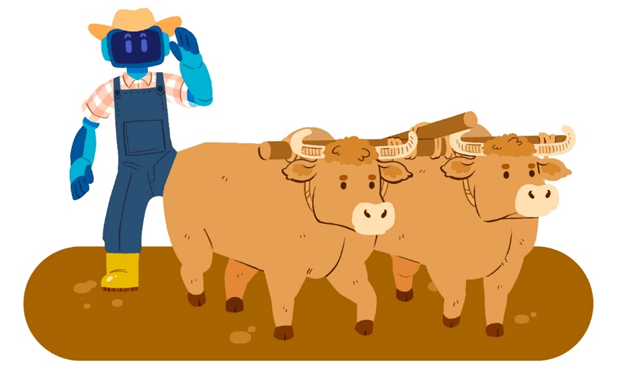 Illustration made by artist Yanni Sophia Noriega, former student of Unicab
It was not until the middle of the 20th century that its true potential was investigated, after the first electronic computers were developed.
Within the fields of systems and computer science, Artificial Intelligence is probably the most spectacular area of research, the one that has attracted the most interest from both novices and scientists, with the goal of making computers think. Furthermore, disciplines such as mathematics and all the basic sciences, psychology, linguistics, philosophy, and, of course, computer science actively participate, as they have shaped, through their contributions, the characteristics of representing and processing information and knowledge. (UNAM, 2018).
Why does Artificial Intelligence generate so much controversy? Will it improve our lives or worsen them?
The UN General Assembly believes that the proper development of this technology fosters digital transformation, promotes peace, bridges the digital divide both within and between countries, and even promotes the protection and enjoyment of human rights. We are left wondering, is all of this true, and how would these benefits be achieved?
On March 22 of this year, the UN adopted its first resolution on Artificial Intelligence, aiming to promote its safe, responsible, and equitable development to prevent inequalities between countries and its potential for malicious use. Given the importance of the issue, the UN urges member states of the General Assembly to review and legislate on the matter.
The debate began in Colombia in 2019 regarding regulatory discussions, governance, and implementation of Artificial Intelligence, and as of 2022, we have two projects underway in the country: the AI public policy lab and the AprendeIA empowerment platform and a document on AI and sustainability was prepared. (GovTech and Public Impact Lab, 2022).
The Bogotá Chamber of Commerce implemented the AI lab initiative to focus on generating value for Colombian society and the economy. (Bogotá Chamber of Commerce, 2021).
To date, there are certainly many other initiatives to review and analyze the importance, scope, and effects of AI, which, as we all know, is a field still under development and will continue to change daily. At the Unicab Research Group (GIU), we observe that despite all that Artificial Intelligence has achieved, thanks to therevolution for natural intelligence which is the main architect of this achievement. We admit that AI still has much to learn and has had a positive impact in areas such as health, finance, education, agriculture, energy, logistics and transportation, and at a commercial level, but it also poses risks, such as for decision-making, since the concepts of Artificial Intelligence can be biased and unfair.
Our readers will agree that other risks may be evident, for example, in the possible violation of privacy, job displacement, being used for malicious purposes such as the development of more sophisticated cyberattacks, raising ethical issues in critical situations such as in the health sector or the justice and security sector, and the concern that Artificial Intelligence may surpass natural, human intelligence to the point of controlling us.
In education, Artificial Intelligence raises a major ethical debate and is a subject of analysis due to its increasing implementation. We are very motivated by its use at Unicab and invite the entire educational community to ensure that its use is rational andDon´t believe the hype. and that, therefore, there is a work of natural intelligence in contrasting with other sources of information the veracity of what AI tells us.
We also want to continue motivating ourselves to argue and support in our own words what we obtain from our research and consultations, to maintain and strengthen our natural cognitive, emotional and volitional faculties that give human beings the capacity for an inner look at our own actions, to value, evaluate, interpret, interact, feel, be moved and respond to the environment… Even to feel fascination and sometimes frustration with the decisions we make.
We continue...

References:
Arrestegui, L. B. (2012). Theoretical and philosophical foundations of Artificial Intelligence. Journal of Research and Culture, 87-92.
Bogotá Chamber of Commerce. (December 13, 2021). Bogotá Chamber of Commerce. Obtained from https://www.ccb.org.co/empresarial/apoyo-sostenibilidad-empresarial/innovaciones-y-soluciones-tecnologicas/sobre-policy-lab
GovTech and Public Impact Lab. (July 25, 2022). Milab. Obtained from https://www.innpulsacolombia.com/milab/noticias/politica-de-inteligencia-artificial-ia-para-colombia
UNAM, G. d. (2018). Intelligent Systems Research Group of the Autonomous University of Mexico. Obtained from https://virtual.cuautitlan.unam.mx/intar/sistdig/algebra-booleana/
Comment
Email - Date
:
Para un maestro en educación escolar virtual, es de vital importancia asumir los retos de los últimos años relacionados no solo son la pedagogía, sino también con la tecnología. Debemos demostrar que nuestra elección de ser maestros se hace por vocación y también por superación personal para responsabilidades en el campo laboral docente. Una clave importante está en aprender a adaptarse a nuevas situaciones para prosperar en el panorama educativo en constante evolución, mantenerse actualizado y ser muy proactivo con el progreso y las necesidades de los estudiantes. Disfrutar el placer de formar ciudadanos preparados para el futuro. Cordial saludo.
example@gmail.com
01-01-25